Important News:SafeLogic Announces General Availability of CryptoComply™ Native Go Read the announcement.


May 28, 2026 •SafeLogic
For federal IT and security leaders, post-quantum cryptography (PQC) has moved from a research topic to an operational priority. The mandate landscape is explicitly clear: OMB M-23-02, National Security Memorandum 10 (NSM-10), and NIST's PQC standards have shifted quantum readiness from a forward-looking planning item into a near-term cybersecurity requirement.
Furthermore, the threat landscape has compressed the timeline for action. "Harvest Now, Decrypt Later" (HNDL) risk means adversaries may already be collecting encrypted federal data with the intent to decrypt once a cryptographically relevant quantum computer becomes available. For agencies responsible for long-lived sensitive data, this risk is not theoretical. Data that must remain protected for 5, 10, or 20 years requires decisions today.
At this point, most federal agencies are aware of the need to migrate to PQC. They understand the vulnerabilities of current public-key cryptography (RSA and elliptic-curve cryptography) and recognize the risks of exposure to classified information, PII, mission data, and other sensitive assets. Most understand that cryptographic inventories, supply chain coordination, and PQC migration roadmaps are now essential.
The harder challenge is execution.
Closing the Execution Gap in PQC Migration
Federal environments are complex: legacy systems, cloud services, custom applications, commercial products, and vendor-managed technologies rarely move at the same pace. Ownership is often fragmented, documentation is incomplete, and some systems are too fragile for rapid modernization.
When confronted with an infrastructure of this scale, agencies frequently succumb to "analysis paralysis." Security teams often attempt a traditional waterfall approach: discover every cryptographic asset, design a flawless master architecture, resolve every dependency, and only then begin remediation.
During a recent Carahsoft-hosted webinar, "From Mandate to Execution: Operationalizing Post-Quantum Cryptography and Crypto-Agility Across Federal Systems," SafeLogic CEO Evgeny Gervis joined federal cybersecurity experts to address this operational inertia. One of his key points was direct:
"No one is going to plan or discover their way to quantum resilience. Agencies have to begin moving, learn from early implementation, and use those practical lessons to iteratively strengthen their security posture over time. You don't learn how to swim by reading about it—you have to jump into the pool."
— Evgeny Gervis, SafeLogic CEO
The takeaway is clear: PQC migration cannot be treated as a linear compliance exercise. It requires an agile, iterative operating model. Agencies must establish an adaptable roadmap that accommodates evolving NIST recommendations, shifting vendor capabilities, and newly uncovered infrastructure realities.
The path forward demands controlled pilots, risk-prioritized remediation, and continuous, cross-functional collaboration among cyber, mission, and procurement teams. Closing the execution gap means recognizing that quantum readiness is an ongoing operational evolution, not an IT project with a fixed end date.
Watch the Full Webinar Replay:
PQC as a Catalyst for Cryptographic Governance and Crypto-Agility
While the shift to post-quantum cryptography is an urgent technical requirement, it also exposes a deeper governance challenge: many organizations lack mature visibility, control, and policy enforcement over how cryptography is used across their enterprise.
When cryptographic functions are hardcoded directly into application logic — often by developers who are not cryptographers — they become effectively invisible. These functions perform critical security work every day, yet they are difficult to inspect, trace, govern, or update. When an algorithm is compromised or a standard changes, organizations are often forced into an enterprise-wide fire drill that requires opening codebases and rewriting applications from scratch.
PQC migration cannot be reduced to a simple algorithm swap. It presents a strategic opportunity to address this long-standing governance gap. Instead of repeated disruptive updates, agencies should move toward a centralized control panel model with three core capabilities:
- Comprehensive Visibility — Knowing exactly where and how cryptography is implemented across applications and infrastructure, with continuous monitoring to detect policy violations.
- Centralized Authority — The ability to enforce consistent cryptographic policies across the entire enterprise.
- Dynamic Swap Capability — The flexibility to update, isolate, or replace cryptographic components without rewriting underlying application code.
This is the essence of true crypto-agility. A crypto-agile agency does not treat cryptographic change as an emergency. It treats cryptography as a governed, modular infrastructure service that can adapt seamlessly as standards, threats, and mission needs evolve.
Active Risk Mitigation: Prioritizing by Data Longevity and Trust
Enterprise-wide PQC migration cannot happen overnight. Agencies need a defensible, risk-based prioritization model built on two key concepts:
- Harvest Now, Decrypt Later (Confidentiality Risk): Focus on data that must remain protected for the longest periods.
- Trust Now, Forge Later (Integrity & Authentication Risk): Protect digital signatures, certificates, identity systems, and software validation chains that quantum capabilities could later undermine.
A practical prioritization matrix can help:
| Priority | Data Longevity | Impact of Compromise | Recommended Approach |
|---|---|---|---|
| Tier 1 | 10+ years | Catastrophic (Classified / Mission-critical) | Native PQC or immediate hybrid layering |
| Tier 2 | 5 - 10 years | Severe (PII / Operational disruption) | Phased upgrades + active monitoring |
| Tier 3 | < 5 years | Moderate | Scheduled replacement + controls |
| Tier 4 | Near retirement | Variable | Isolation, segmentation, or encapsulation |
This matrix should be informed by mission criticality, system ownership, exposure, and available remediation paths. Bringing mission and system owners into the conversation early creates shared ownership and clearer decision-making.
A Four-Step Operational Framework for Quantum Readiness
Successful PQC programs follow a structured yet flexible approach:
Step 1: Operational Enablement
Technology migrations succeed through people first. Enable executives, mission leaders, technical teams, procurement, and compliance stakeholders with role-appropriate knowledge. Frame PQC as an extension of existing efforts — Zero Trust, cloud modernization, and risk management — rather than a standalone mandate. Secure sustained executive sponsorship and break down silos early.
Step 2: Strategic Blueprinting
Build a realistic plan that accounts for legacy constraints, vendor dependencies, and mixed ownership. Define prioritization logic, governance rules, decision rights, and alternative remediation paths (including segmentation or compensating controls for systems that cannot be upgraded quickly). The blueprint serves as a north star while allowing flexibility as standards and vendor capabilities mature.
Step 3: Strategic Hybrid Modernization
Hybrid cryptographic environments will persist for years. Design for coexistence: combine classical algorithms with PQC standards (such as ML-KEM and ML-DSA) where needed. A logical starting point is data in transit — particularly internal TLS connections, where agencies control both endpoints. Emphasize validated, FIPS 140-3 compliant implementations and maintain interoperability during the transition.
Step 4: Institutionalizing Agility
The goal is to make cryptographic change routine. Move toward abstraction layers, common APIs, centralized policy enforcement, and modular cryptographic services. When applications consume cryptography without being tightly coupled to specific algorithms, future transitions become configuration updates rather than enterprise-wide crises.
🔽 Download the graphic for future reference
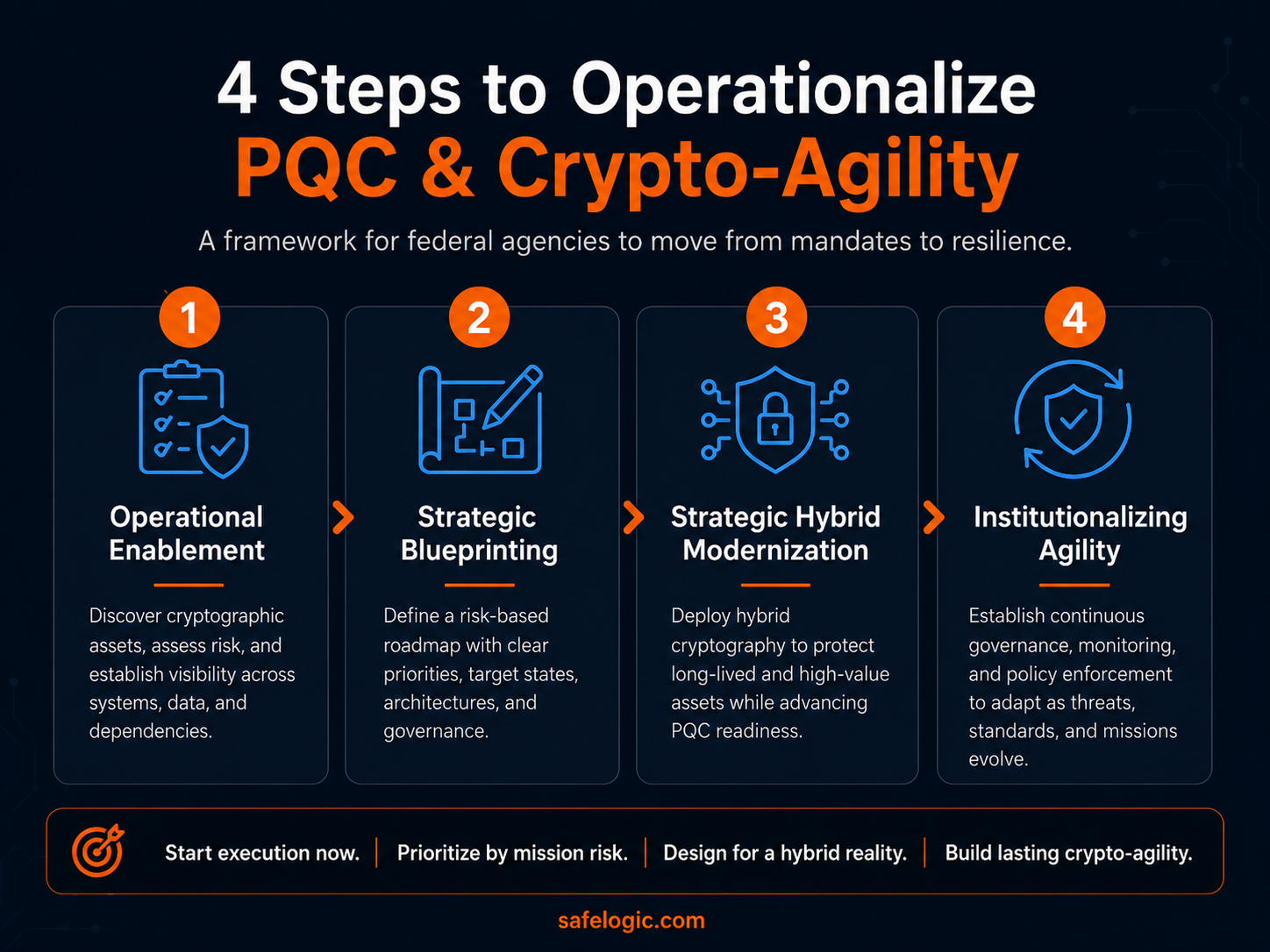
Want to share this infographic? Click below to copy the embed code for your site.
Takeaways for Federal Leaders
- Start execution now. Extended discovery alone will not deliver quantum resilience. Begin with controlled pilots and learn iteratively.
- Let mission risk drive prioritization. Focus on data longevity, trust dependencies, and mission impact.
- Treat PQC as change management. Workforce enablement, leadership sponsorship, and governance matter as much as technology.
- Design for hybrid reality. Plan for coexistence and interoperability.
- Build lasting crypto-agility. Use this transition to create visibility, control, and adaptability for future cryptographic shifts.
Moving from PQC Planning to Action
Quantum readiness is an operating model, not a one-time project. The agencies that succeed will treat PQC migration as a catalyst for stronger cryptographic governance and long-term crypto-agility.
To help federal teams operationalize these concepts, SafeLogic offers two practical resources:
- The Continuous PQC Remediation Checklist — a tool to turn discovery into ongoing risk reduction as systems, vendors, and threats evolve.
- The Cryptography Maturity Action Plan (CMAP) — a framework to assess your current maturity and build a phased roadmap for post-quantum readiness.
Download the Continuous PQC Remediation Checklist and explore CMAP, or schedule a conversation with a SafeLogic PQC expert to discuss your agency’s specific roadmap and challenges.