Important News:SafeLogic Announces General Availability SafeLogic CPM Read the announcement.


April 28, 2026 •Brendan Sheairs

A Practical Path to Post-Quantum Readiness
Quantum computing is no longer a distant concept; it is an approaching reality with direct implications for today’s cryptographic foundations. Algorithms like RSA and ECC, which currently secure the global digital infrastructure, will soon not withstand the capabilities of quantum computers. Organizations that wait will find themselves exposed. Organizations that prepare will maintain trust, protect data, and stay ahead of regulatory and market expectations.
That’s why SafeLogic developed the Cryptography Maturity Action Plan (CMAP)—a structured, actionable framework designed to help organizations assess, prioritize, and execute their transition to post-quantum cryptography (PQC).
What CMAP Is—and Why It Matters
CMAP is a four-level maturity model that helps organizations evaluate and improve their cryptographic posture across people, processes, and technology. It focuses specifically on cryptographic risk management and PQC transition—complementing broader frameworks like the Building Security In Maturity Model (BSIMM), an observation-based, data-driven framework that measures and benchmarks software security initiatives across organizations.
At its core, CMAP helps you determine three critical questions:
- Where are we today?
- What does "good" look like?
- How do we get there?
It aligns with established standards, including the NIST Cybersecurity Framework (CSF) and NIST SP 800-53, enabling organizations to integrate PQC readiness into their existing security and compliance programs.
Most importantly, CMAP provides a practical, step-by-step roadmap—not just theory.
The Four Levels of Cryptographic Maturity
CMAP defines four maturity levels that reflect how deeply cryptographic best practices are embedded in an organization:
- Level 1 – Ad Hoc
Cryptographic practices are reactive, undocumented, and siloed. - Level 2 – Developing / Repeatable
Initial processes and awareness exist, but efforts are inconsistent and not yet enterprise-wide. - Level 3 – Defined / Proactive
Policies, inventories, and plans are formalized, documented, and actively managed. - Level 4 – Optimized / Adaptive
Cryptographic risk is continuously measured and improved, with full integration into enterprise operations and rapid adaptation to new threats and standards.
These levels are not abstract—they are observable. CMAP defines concrete activities at each stage so organizations can benchmark themselves and track progress over time.
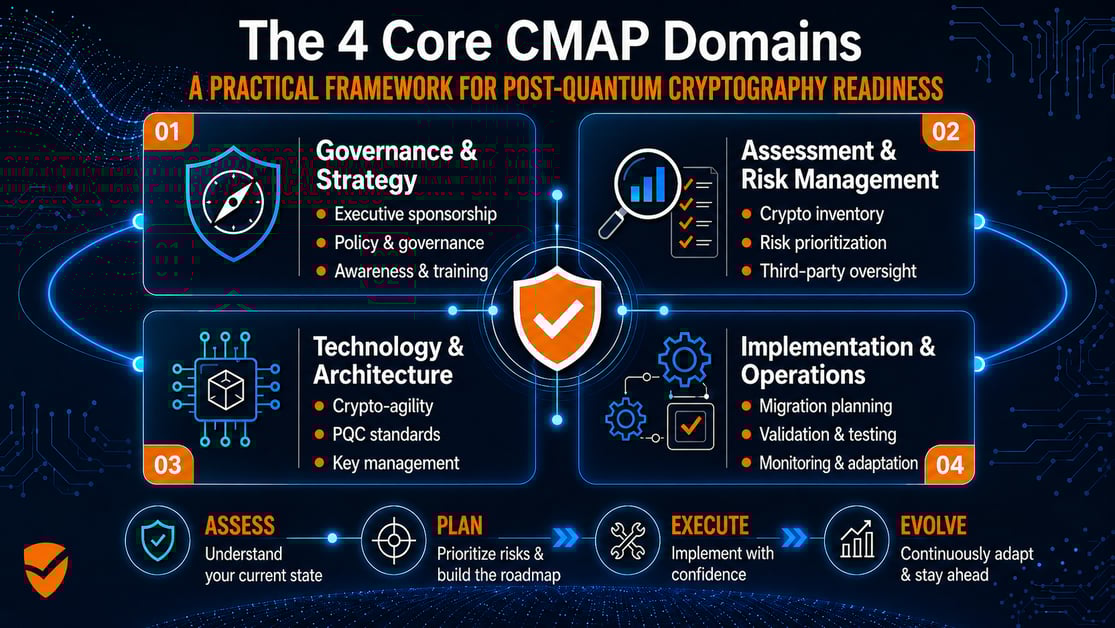
The 12 Core CMAP Practices
CMAP organizes cryptographic readiness into 12 core practices, grouped across four domains. Each practice includes clear objectives and maturity-level behaviors, making it easy to assess your current state and define the next steps.
1. Governance and Strategy
You cannot succeed without executive alignment and clear direction.
CMAP starts by ensuring:
- Executive sponsorship and strategy (Practice 1)
- Formal governance and cryptographic policy frameworks (Practice 2)
- Awareness and training programs (Practice 3)
At higher maturity levels, organizations move from informal awareness to board-level reporting, defined KPIs, and active participation in industry efforts.
2. Assessment and Risk Management
You can’t fix what you don’t understand.
CMAP emphasizes:
- Comprehensive cryptographic inventory and discovery (Practice 4)
- Quantum-aware risk modeling and prioritization (Practice 5)
- Third-party and supply chain risk management (Practice 6)
At maturity, organizations maintain real-time visibility into cryptographic usage, map risks to business impact, and extend requirements to vendors and partners.
3. Technology and Architecture
Mapping policy with commonly used architectural patterns will help engineers adopt best practices more efficiently.
CMAP drives:
- Cryptographic agility in system design (Practice 7)
- Architecture selection and adoption of PQC standards (Practice 8)
- Modernized key management and cryptographic infrastructure (Practice 9)
Organizations progress from rigid, hard-coded cryptography to fully agile systems capable of switching algorithms with minimal disruption—a foundational requirement for PQC readiness.
4. Implementation and Operations
Strategy only matters if you can execute.
CMAP ensures organizations:
- Develop and execute phased PQC migration plans (Practice 10)
- Test and validate cryptographic implementations rigorously (Practice 11)
- Continuously monitor, audit, and adapt cryptographic posture (Practice 12)
At the highest level, cryptographic transition becomes a repeatable organizational capability, not a one-time project.
How to Use CMAP
CMAP is designed to be actionable from day one. Here’s how to put it to work:
1. Assess Your Current State
Start by mapping your organization against the 12 practices and four maturity levels.
Be honest:
- Do you have a cryptographic inventory?
- Is PQC part of your strategic roadmap?
- Can your systems swap algorithms without code changes?
This baseline becomes your starting point.
2. Identify Gaps and Prioritize
Not every gap carries equal risk.
Focus first on:
- High-value data with long confidentiality lifetimes
- Systems exposed to “harvest-now, decrypt-later” or “trust now, forge later” threats
- Critical dependencies on third-party cryptography
Use CMAP’s structure to align priorities with real risk—not just perceived urgency.
3. Build a Phased Roadmap
CMAP supports a crawl → walk → run approach—to pragmatically mature your PQC readiness.
Typical progression:
- Build inventory and awareness
- Define governance and risk models
- Introduce crypto-agility and pilot PQC
- Scale deployment across the enterprise
Avoid the temptation to “boil the ocean.” Controlled, phased execution wins.
4. Integrate Across the Organization
PQC readiness is not just a security initiative.
It requires coordination across:
- Engineering and architecture
- Risk and compliance
- Procurement and vendor management
- Executive leadership
CMAP helps create a shared language so all stakeholders move in the same direction.
5. Continuously Measure and Adapt
Quantum timelines will evolve. Standards will change.
Organizations at higher maturity levels:
- Track KPIs for cryptographic risk reduction
- Monitor external developments (e.g., NIST updates)
- Adjust plans dynamically
CMAP is not a static checklist—it is a continuous improvement model.
Final Thoughts
The transition to post-quantum cryptography is one of the most significant security shifts of our time. It is also one of the most complex—touching every system, every application, and every partner in your ecosystem.
CMAP provides a clear, structured way forward.
It helps you:
- Understand your current exposure
- Build organizational alignment
- Modernize your architecture
- Execute with confidence
Most importantly, CMAP enables you to move from uncertainty to action.
The organizations that start now will not just survive the quantum era—they will lead it.
If you would like to learn more or have questions, my team is available for a PQC consultation.