NATO’s newly released Quantum Technology Roadmap sends an important message to governments, defense organizations, technology providers, and the broader security community: quantum readiness is moving from strategy to execution.
Published on September 29, 2026, the roadmap builds on NATO’s 2023 Quantum Technology Strategy and lays out a more actionable path for accelerating the understanding, adoption, and integration of quantum technologies across NATO and Allied armed forces. Its goal is straightforward but significant: help the Alliance become quantum-ready.
The roadmap covers the opportunities created by quantum computing, quantum communications, and quantum sensing. But just as importantly, it addresses the security risks quantum technologies create for the systems and cryptography organizations rely on today.
For cybersecurity leaders, one area deserves particular attention: post-quantum cryptography is no longer treated as a future consideration. It is becoming an operational requirement.
How NATO Is Moving From Quantum Strategy to Implementation
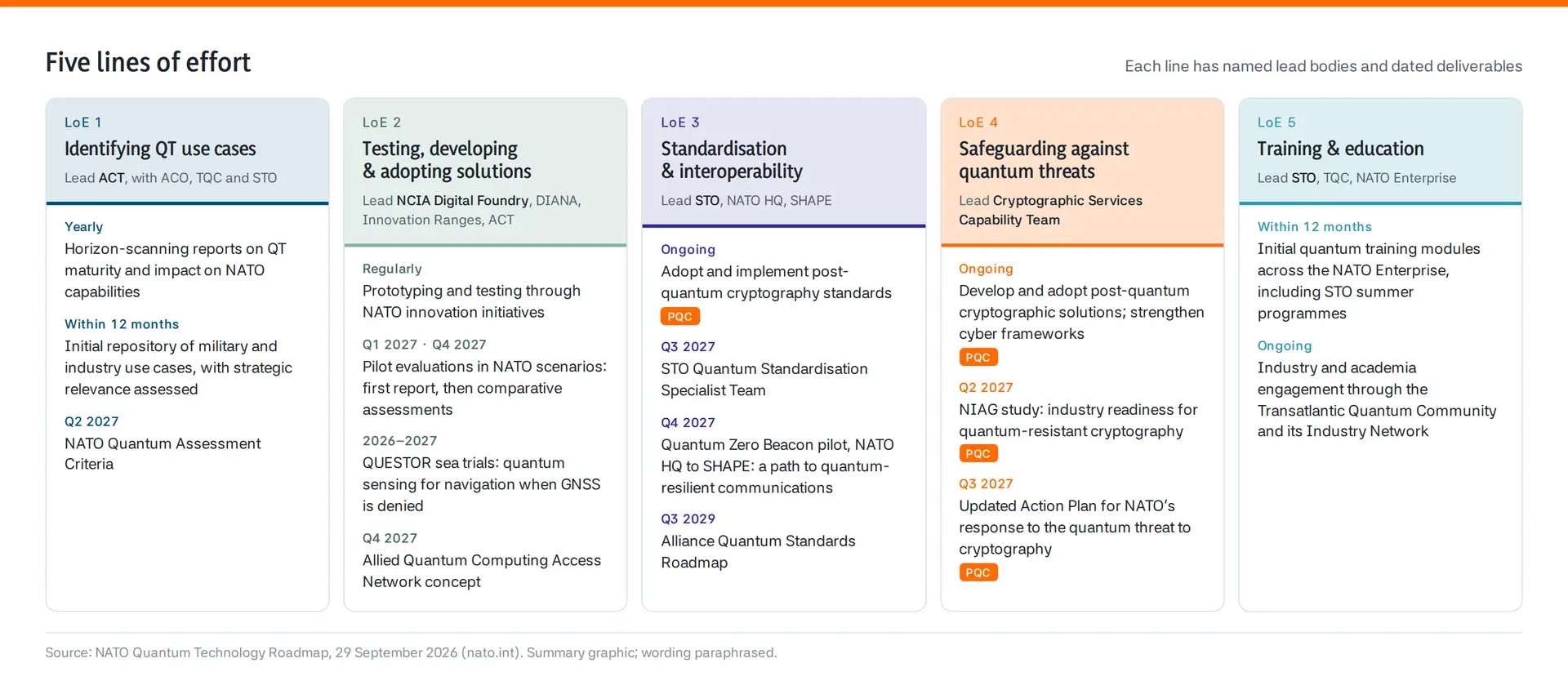
One of the roadmap’s most important aspects is its emphasis on putting quantum strategy into practice.
NATO identifies several lines of effort spanning quantum use cases, prototyping, standards, interoperability, risk mitigation, and training. The Alliance intends to work closely with Allied governments, industry, academia, and research organizations to move promising technologies from experimentation toward operational deployment.
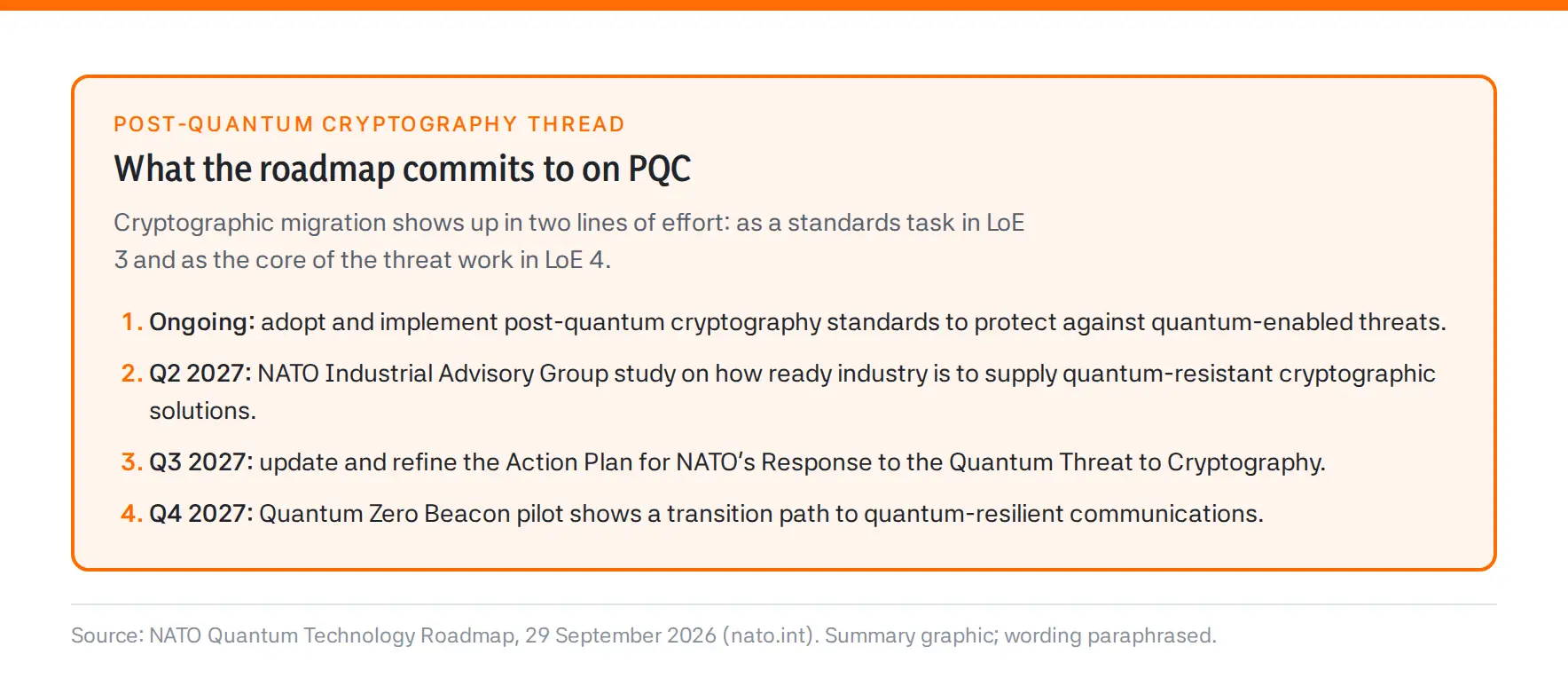
For cryptography specifically, NATO calls for the ongoing adoption and implementation of post-quantum cryptography standards to protect against quantum-enabled threats. It also lays out several concrete activities, including:
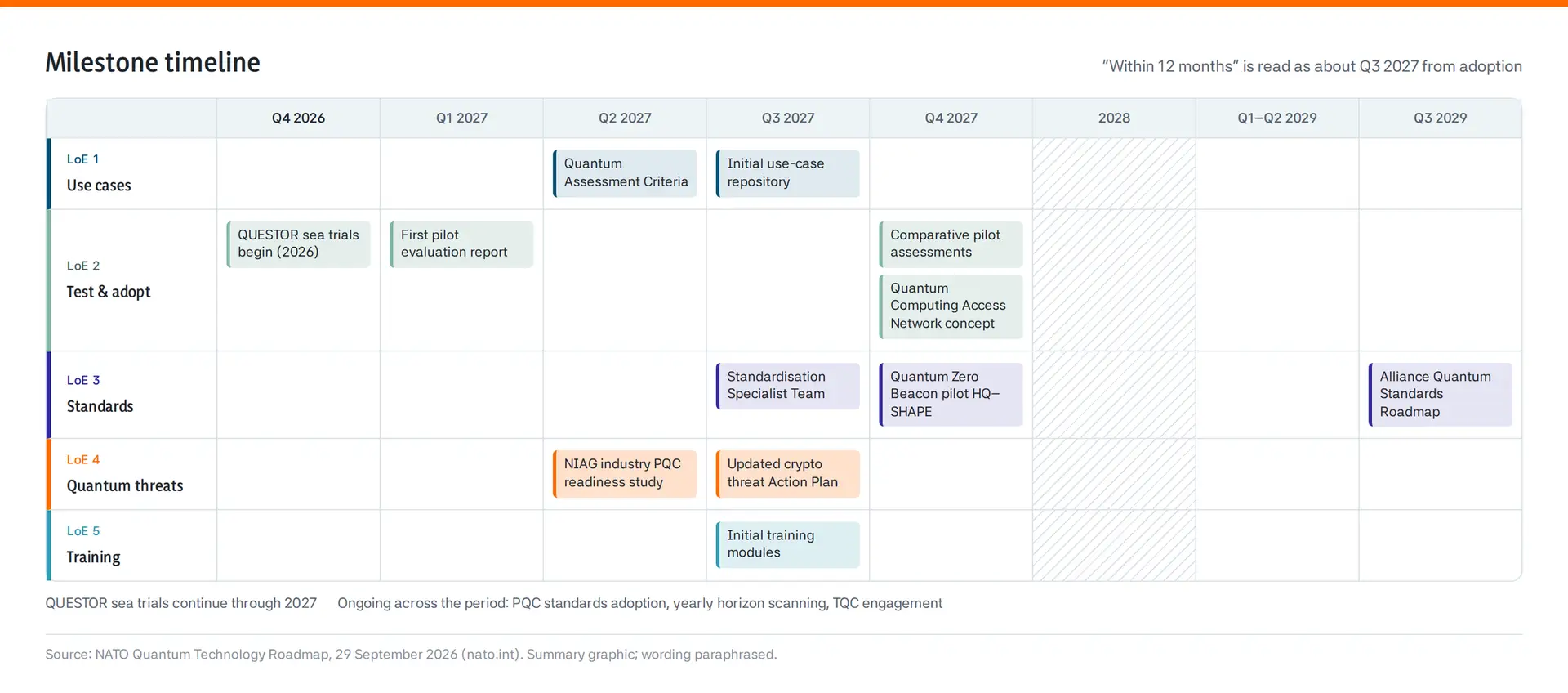
- Updating NATO’s Action Plan for responding to the quantum threat to cryptography, with the next update planned for Q3 2027.
- Conducting a NATO Industrial Advisory Group study on industry readiness for quantum-resistant cryptographic solutions, targeted for Q2 2027.
- Establishing a Quantum Standardization Specialist Team.
- Developing a broader Alliance roadmap for quantum standards.
- Advancing the Quantum Zero Beacon Project, a pilot between NATO Headquarters in Brussels and SHAPE in Mons designed to demonstrate a practical path toward quantum-resilient communications.
These initiatives reinforce an increasingly clear direction: adopting PQC standards is only part of the challenge.
Organizations also need to understand where cryptography exists, determine which systems require migration, evaluate operational dependencies, implement new algorithms safely, maintain interoperability, and continue adapting as standards evolve.
That is a much larger problem than simply replacing one algorithm with another.
Why Cryptographic Discovery Is the First Step in PQC Migration
Organizations cannot effectively migrate cryptography they cannot see.
Cryptography is often distributed across applications, source code, third-party libraries, operating systems, certificates, network connections, cloud infrastructure, embedded devices, and production environments. In large organizations, there may be thousands, or millions, of cryptographic implementations with different owners, dependencies, data sensitivity, and migration requirements.
That means the first milestone in a successful PQC program is understanding where cryptography is used, what is vulnerable, what matters most, and what needs to change first.
This is especially important for defense organizations and the companies supporting them, where systems may remain deployed for decades and sensitive information may need to stay protected long into the future.
A cryptographic inventory provides the foundation, but it’s not enough. Organizations need context.
Which assets rely on RSA or ECC? Which protect long-lived sensitive information? Which systems are externally exposed? Which applications depend on third-party cryptographic libraries? Which implementations can be upgraded quickly, and which require significant engineering work?
Answering those questions allows teams to move from a theoretical PQC program to a risk-based migration plan.
How to Move From Cryptographic Discovery to PQC Remediation
This is where Cryptographic Posture Management becomes increasingly important.
SafeLogic CPM helps organizations continuously discover, inventory, prioritize, and govern cryptography across their environment. Rather than treating cryptographic inventory as a one-time assessment, CPM gives security and engineering teams ongoing visibility into how cryptography is used and where to prioritize remediation.
That provides a practical starting point for the kind of quantum readiness NATO is encouraging.
Once organizations understand their cryptographic exposure, the next step is remediation.
SafeLogic supports that transition through two complementary approaches.
CryptoComply™ provides FIPS 140-3 validated cryptographic software for organizations that need to maintain regulatory or government compliance while preparing for the post-quantum transition. SafeLogic’s current CryptoComply platform supports NIST-standardized PQC algorithms including ML-KEM, ML-DSA, and SLH-DSA, alongside validated classical cryptography and hybrid deployment approaches.
For organizations whose primary objective is enterprise PQC modernization, SafePQ™ provides commercially supported post-quantum cryptographic software with NIST-standardized algorithms, hybrid classical/PQC deployments, broad operating-environment coverage, and integration models designed to reduce application redesign.
Together, these capabilities allow organizations to connect discovery with remediation rather than treating them as separate projects.
Why PQC Interoperability Matters as Much as Algorithm Selection
NATO’s emphasis on standards and interoperability matters just as much.
Cryptography does not operate in isolation. Algorithms must work across applications, devices, protocols, vendors, government systems, coalition partners, and technology generations.
A PQC implementation that works technically but cannot interoperate across an operational ecosystem solves only part of the problem. Organizations therefore need to consider much more than whether an implementation supports ML-KEM or ML-DSA. They also need to test how those algorithms interact with existing systems, protocols, certificates, network infrastructure, and partner environments.
Hybrid cryptographic approaches will play an important role during this transition. By combining established classical cryptography with post-quantum algorithms, organizations can begin introducing quantum-resistant protections while maintaining compatibility with systems that have not yet fully transitioned.
The result is a migration that can happen incrementally rather than through a disruptive, organization-wide cutover.
Quantum Readiness Requires Crypto-Agility
Perhaps the larger lesson from NATO’s roadmap is that PQC migration should not be viewed as the final cryptographic transition.
Standards will continue to evolve. Algorithms may be updated or deprecated. New vulnerabilities will emerge. Regulatory requirements will change. New quantum-resistant technologies will mature.
Organizations therefore need more than a migration project. They need crypto-agility.
Crypto-agility is the ability to discover, govern, replace, and update cryptography without requiring major application or infrastructure redesign each time the cryptographic landscape changes.
SafeLogic approaches crypto-agility by connecting continuous cryptographic visibility, policy, cryptographic software, PQC migration, lifecycle management, and operational delivery.
For organizations preparing for the quantum era, the objective should extend beyond simply replacing vulnerable cryptography. The more sustainable approach is to build an environment where cryptographic changes can be made efficiently, repeatedly, and with minimal disruption as standards, technologies, and threats continue to evolve. That is the foundation of long-term crypto-agility.
From Quantum Readiness to Operational PQC Migration
NATO’s roadmap further shows that the global conversation around quantum security is changing. The question is increasingly no longer whether organizations should prepare for post-quantum cryptography. The question is whether they have the visibility, technology, processes, interoperability, and governance needed to execute that transition successfully.
The path forward begins with understanding the cryptographic environment, prioritizing the systems that matter most, introducing quantum-resistant cryptography in a controlled way, validating interoperability, and building the crypto-agility necessary to respond as standards and threats continue to evolve.
NATO is working toward making the Alliance quantum-ready. Organizations supporting NATO, governments, critical infrastructure, and other security-sensitive environments should be doing the same.
SafeLogic helps organizations move from quantum-readiness strategy to implementation by connecting cryptographic discovery, risk prioritization, FIPS 140-3 validated cryptography, post-quantum remediation, and continuous cryptographic governance.
The quantum transition will take years. The work required to prepare for it needs to start now.
Start your PQC migration today!